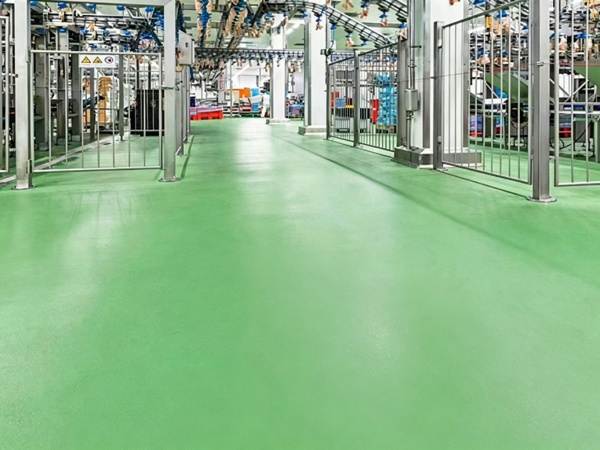

1. Environmentally friendly, anti-static, extremely low VOC, free of heavy metals, and odorless during use, it meets the requirements of food hygiene and quality.
2. It features matte finish and is aesthetically pleasing. Antibacterial and bacteriostatic; Easy to clean and maintain.
3. The coating obtained by chemically hybridization and compounding high-performance polyurethane with high-strength cement and silica sand is resistant to damage and has toughness when subjected to impact or deformation, without causing cracks or delamination.
4. Resistant to various organic acids, alkalis, amines, salts and solvents.
5. The coefficient of thermal expansion is similar to that of concrete. During normal thermal cycling, there will be no displacement difference between the coating and the concrete substrate, no delamination or cracking, and it maintains its physical properties within the temperature range of -5° C to 50°C.
6. Fast curing speed and short construction period.
Base surface treatment:
The treatment of the base concrete is the key to doing a good job with the polyurethane concrete floor. The quality of the floor treatment directly affects the service life of the floor. To enhance the adhesion between the base and the floor, mechanical treatment methods (such as shot blasting) should be adopted to expose the concrete aggregates. The surface of the floor must be grooved, and the depth and width of the groove should be 2 to 3 times the thickness of the polyurethane mortar floor. Especially at all the edges (such as trenches, etc.), grooves should be cut 20mm away from them.
Apply the primer:
After the base surface is thoroughly cleaned, mix the SPR-23101P polyurethane universal self-leveling mortar material evenly according to the designed ratio. Then, pour it into a separate bucket and mix it again. Use the troweling method for application. It is necessary to strictly control the filling of each groove and gap. After the material is mixed, apply it continuously with a trowel. This step cannot be stopped and should be completed as soon as possible. To ensure good adhesion of the material. To ensure that the base layer is completely sealed, a polyurethane primer of 1mm is more suitable.
Lay copper foil:
After the polyurethane mortar primer has cured, attach the copper foil to the primer as per the design requirements (generally 3m*3m).
Application of water-based conductive primer:
Mix the SPR-21105ESD waterborne epoxy resin anti-static primer evenly according to the ratio, then pour it into a separate bucket and stir it again. Apply it evenly on the ground with a roller, ensuring no areas are missed. After curing, measure its resistance. Generally, the measured resistance should be below 10 to the power of five.
Topcoat application:
Mix the SPR-23106ESD polyurethane anti-static self-leveling mortar according to the proportion (using a low-speed double-head or spiral blade mixer), pour it into a separate bucket and stir it again. Then, spread the material evenly to a certain thickness with a rake, level it with a trowel, and roll it back and forth with a defoaming roller. After the material is well mixed, spread it continuously without interruption. This step should be completed as quickly as possible To ensure a good surface effect and adhesion.

Processing areas with high requirements for chemical corrosion, areas with high requirements for electrostatic conduction performance that need to control electrostatic current, chemical processing, solvent storage and treatment workshops, communication products, large precision instruments and other fields.


 Tel:400-168-5168
 Web:www.sprpaint.com
 Headquarters Address:No. 8, Building 7, Science Road 10, Songshan Lake Industrial Zone, Dongguan City, Guangdong Province
 Douyin QR code
 Corporate culture
 Project Case